Open Enrollment 2027: Key Dates Every DFW Household Needs to Know
 Posted in Uncategorized last updated on October 9, 2026
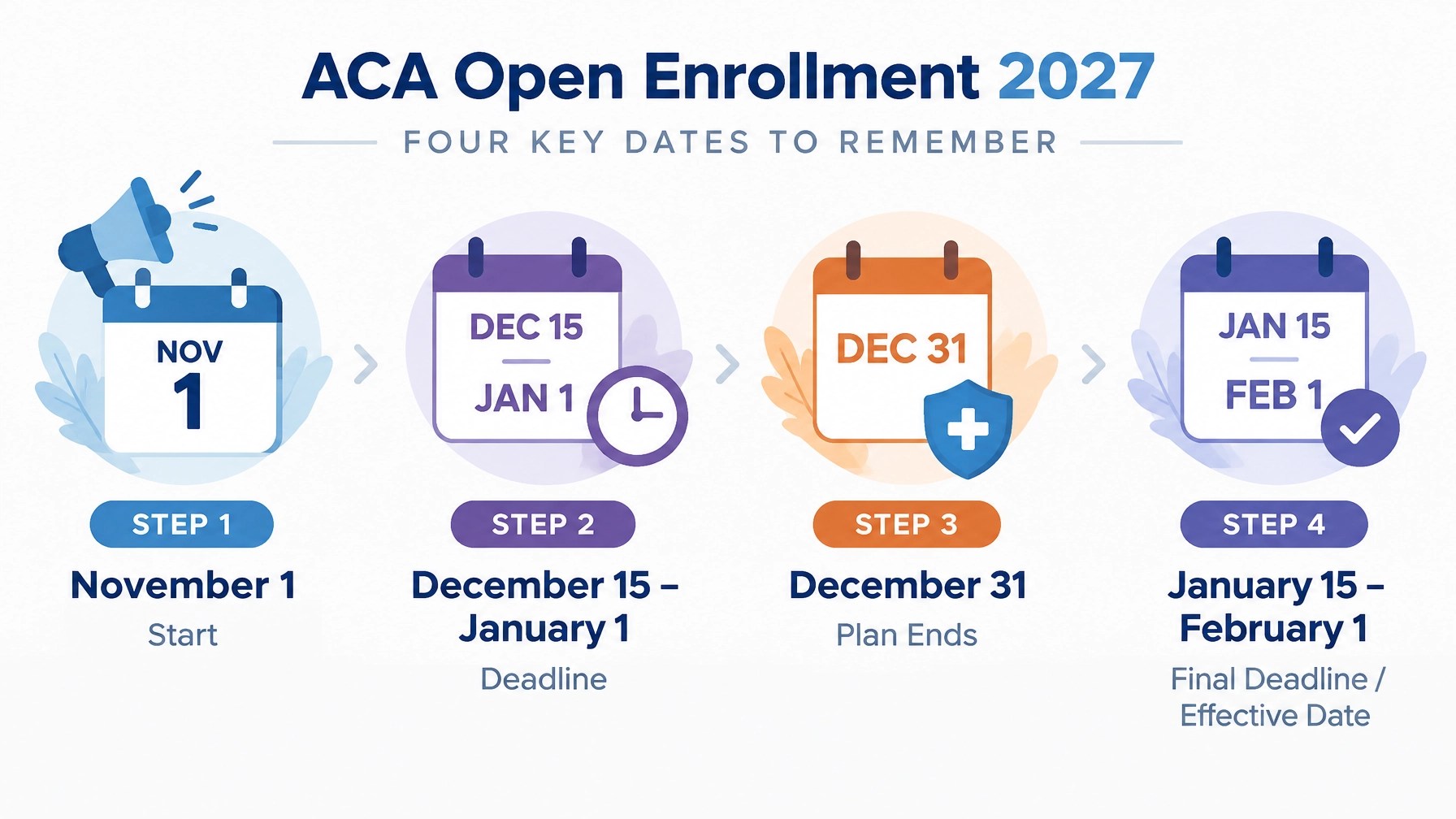
ACA Open Enrollment for 2027 health coverage begins November 1, 2026, and ends January 15, 2027. This period allows individuals and families to enroll in a Marketplace plan, renew existing coverage, or select a different plan for the new year.
For households seeking health insurance in Fort Worth Texas, health insurance Fort Worth TX, or coverage across the broader health insurance DFW market, meeting the key deadlines is essential. The date a household enrolls determines when coverage begins.
This year also requires additional planning for people enrolled in Baylor Scott & White Health Plan Individual & Family Marketplace coverage. Baylor Scott & White Health Plan has announced that these plans will end after December 31, 2026.
2027 ACA Open Enrollment timeline
The following dates apply to 2027 Marketplace coverage through HealthCare.gov in Texas.
| Date | What happens |
|---|---|
| November 1, 2026 | Open Enrollment begins. Consumers can apply, renew, or change Marketplace plans. |
| December 15, 2026 | Last day to enroll or change plans for coverage beginning January 1, 2027. |
| December 31, 2026 | Baylor Scott & White Health Plan Individual & Family Marketplace coverage ends after this date. |
| January 1, 2027 | Coverage begins for applicants who enroll by December 15 and pay the first premium. |
| January 15, 2027 | Open Enrollment ends. This is the final day to enroll or change plans for 2027. |
| February 1, 2027 | Coverage begins for applicants who enroll between December 16, 2026, and January 15, 2027, and pay the first premium. |
The standard Marketplace calendar does not include a December 1, 2026, coverage start date for this Open Enrollment period. Applicants who want coverage to begin January 1 must complete enrollment by December 15.
For official information, review the HealthCare.gov dates and deadlines.
Why December 15 is the most important deadline
January 1 coverage is generally the best option for households that want uninterrupted insurance protection during the new year. To receive that effective date, the application and plan selection must be completed by December 15, 2026.
The first premium must also be paid to the insurance company. Enrollment is not complete until the insurer receives payment according to its instructions.
People who enroll between December 16 and January 15 can still obtain 2027 Marketplace coverage. However, the coverage effective date is generally February 1, 2027. This may leave a January coverage gap for anyone whose current plan ends on December 31.
Consumers should not wait until January if they need coverage to begin immediately after their current plan ends.
Baylor Scott & White Marketplace plan changes
Baylor Scott & White Health Plan has notified regulators of its intent to discontinue Individual & Family Marketplace plans after December 31, 2026. This change affects individual and family ACA Marketplace coverage in Texas. It does not mean that Baylor Scott & White hospitals or clinics are closing.
According to the Baylor Scott & White Health Plan Marketplace FAQ, current coverage, benefits, and services remain in place through December 31, 2026, as long as premiums remain current. Affected members need to select a new health plan for 2027.
Households enrolled in a Baylor Scott & White Individual & Family Marketplace plan should:
- Check the insurance card and Marketplace account to confirm the current carrier.
- Continue paying premiums through the end of 2026.
- Review plan options beginning November 1.
- Confirm that doctors, hospitals, medications, and treatment facilities are covered by the replacement plan.
- Enroll by December 15 to target January 1 coverage.
- Ask the new plan about transition-of-care policies for ongoing treatment or prescriptions.
Baylor Scott & White Health advises members to verify that providers are in network under the new plan. Consumers can also review the Baylor Scott & White accepted insurance information.
Automatic plan assignment may occur when an insurer leaves the Marketplace. However, households should not rely on automatic enrollment. An assigned plan may have different premiums, deductibles, provider networks, or prescription benefits. Selecting a plan directly provides greater control over coverage.
What to do before November 1
Preparing documents and reviewing current coverage before Open Enrollment can make the application process more efficient.
Gather household and income information
The Marketplace uses expected household income for the coverage year to determine eligibility for premium tax credits and other savings. Gather:
- Social Security numbers for household members applying for coverage
- Dates of birth
- Current addresses
- Immigration documents, when applicable
- Recent tax information
- Pay stubs or other income records
- Information about expected 2027 income
- Employer coverage information
- Current insurance policy details
Income may be more difficult to estimate for self-employed people, seasonal workers, unemployed individuals, and people between jobs. The application should reflect the best estimate of total household income for 2027. Update the estimate if circumstances change.
HealthCare.gov provides a Marketplace application checklist to help consumers prepare.
Read plan and Marketplace notices
By November 1, current Marketplace enrollees should receive information from both the insurance company and the Marketplace. These notices may explain:
- Whether the current plan will be available in 2027
- Whether the premium or benefits will change
- Whether the household is being matched with another plan
- Whether additional documents are required
- How financial assistance may change
Do not assume that a current plan will renew with the same price, network, or benefits. Review the notices carefully and compare available plans.
Confirm whether the carrier or plan is changing
Plan and carrier changes can affect access to doctors and hospitals across the Dallas-Fort Worth area. This is especially important for households receiving care through a specific hospital system, managing a chronic condition, or taking regular prescriptions.
Consumers should make a short list of preferred providers and medications before comparing plans. This list can be used to check each plan’s network and formulary.
How to compare 2027 health insurance plans
The lowest monthly premium is not always the lowest total-cost option. A practical comparison should consider the full cost of using the plan.
Premiums
The premium is the monthly amount paid to maintain coverage. Compare the premium after any applicable Marketplace savings, not only the full price shown before financial assistance.
A lower premium may be useful for a household with limited monthly income. However, it may come with a higher deductible or greater costs when receiving medical care.
Deductibles and out-of-pocket maximums
The deductible is the amount a policyholder generally pays for covered services before the plan begins sharing more of the cost. The out-of-pocket maximum limits what the household pays for covered, in-network services during the plan year.
Review both figures together. A plan with a higher premium may have a lower deductible and may be more suitable for a household that expects regular appointments, procedures, or prescriptions.
Provider networks
Network type and provider participation are central to selecting coverage. Confirm that preferred primary care physicians, specialists, hospitals, urgent care locations, and behavioral health providers are included.
A provider’s office may not have the most current information about every plan. Use the carrier’s online directory and contact the insurer directly before enrolling.
Prescription coverage
Check whether regular medications are included in the plan’s formulary. Review the drug tier, copayment or coinsurance, pharmacy requirements, and any prior authorization rules.
A plan with a low premium may have higher prescription costs for specific medications.
Estimated yearly cost
Consider the premium, deductible, copayments, coinsurance, prescription expenses, and out-of-pocket maximum. HealthCare.gov and insurance carriers provide tools that can help estimate yearly costs based on expected medical use.
DFW Health Coverage can also help consumers compare these factors across plans from leading carriers. The agency provides access to individual, family, and other health coverage options for households throughout the country.

Special considerations for DFW households
Households in Dallas, Fort Worth, Arlington, and surrounding communities may use providers across multiple hospital systems. A plan that works well for one household may not meet another household’s network or budget needs.
People who recently lost employer coverage, are unemployed, are between jobs, or are graduating from school should review Marketplace eligibility. A qualifying loss of coverage may create a Special Enrollment Period outside the annual enrollment window. Medicaid and CHIP applications are also available year-round for people who qualify.
Medicare-eligible adults should review Medicare enrollment rules separately. Marketplace coverage and Medicare have different eligibility requirements and enrollment periods. DFW Health Coverage also provides information about senior health insurance options.
Get a free 2027 comparison quote
Open Enrollment is the opportunity to review coverage before plan changes take effect. Starting early gives households more time to verify networks, compare costs, update income information, and resolve documentation issues.
DFW Health Coverage helps individuals and families compare health insurance options from trusted carriers. The agency provides personalized guidance for households seeking health insurance Dallas Fort Worth, including people who are self-employed, unemployed, between jobs, students, or transitioning from employer coverage.
Request a free, no-obligation comparison quote through the DFW Health Coverage health insurance page or contact the agency online. For assistance, call 682-551-1221.