HDHP vs. PPO in Fort Worth: Run the 2027 Numbers Before You Pick
 Posted in Uncategorized last updated on November 28, 2026

For 2027 coverage, comparing an HDHP with a PPO by monthly premium alone can miss the bigger cost: what the household may pay for care over the year. The useful comparison adds annual premiums to expected out-of-pocket costs, then accounts for any HSA tax benefit.
That calculation matters for people shopping for health insurance in Fort Worth, Texas, across Tarrant County, and throughout the wider DFW area. Plan availability, rates, provider networks, and financial assistance can change from one year to the next.
Why 2027 is a year to recheck the numbers
Texas’s final median rate increase for the 2027 individual market is 14.56%. A statewide median does not predict a particular household’s premium, but it is a reason to compare updated quotes instead of assuming last year’s plan remains the best fit.
The carrier lineup is changing, too. Tarrant County has 133 Marketplace plans from seven carriers for 2027: Ambetter from Superior HealthPlan, Blue Cross and Blue Shield of Texas, Imperial Insurance Companies, Molina Healthcare, Oscar, UnitedHealthcare, and Wellpoint. Cigna offered plans in 2026 but is not participating in the county for 2027, so some households may need to select a new plan.
Enhanced premium tax credits expired at the end of 2025. Eligibility for premium tax credits is generally limited to households between 100% and 400% of the federal poverty level that do not have access to affordable employer coverage. Any eligible premium tax credit should be reflected in the premium used for the comparison.
HDHP vs. PPO: what actually differs
An HDHP, or high-deductible health plan, describes a cost-sharing design. The deductible is generally higher, and members pay more of the negotiated cost of care before the plan begins sharing costs. A qualifying HDHP can be paired with a Health Savings Account, or HSA.
For 2027, the IRS minimum annual deductible for a traditional HDHP is $1,750 for self-only coverage and $3,500 for family coverage. Its maximum out-of-pocket limit is $8,700 for self-only coverage and $17,400 for family coverage. Outside the Marketplace Bronze and Catastrophic categories, a plan generally must meet these limits and pay for no non-preventive care before the deductible to meet the traditional HDHP rules. See IRS Revenue Procedure 2026-24.
A PPO, or preferred provider organization, describes a provider network. PPO plans generally have in-network and out-of-network coverage, with different costs for each. The labels are not opposites: a PPO can also be an HDHP if its design meets the applicable rules.
There is an important Marketplace exception. Since January 1, 2026, all Marketplace Bronze and Catastrophic plans are HSA-compatible by definition, even if they do not meet the traditional IRS HDHP design rules. An HDHP-style design may also be offered at the Silver level, but it must follow the regular IRS requirements.
Compare annual cost, not one line on the quote
Start with the plan’s annual premium after any eligible premium tax credit. Then estimate the in-network costs for the care the household expects to use, including prescriptions, office visits, tests, and planned procedures. Apply the plan’s deductible, copays, coinsurance, and out-of-pocket maximum to estimate what the household may pay.
For HSA-qualified coverage, include the potential tax benefit as well. HSA contributions are pre-tax or tax-deductible, account growth is tax-free, and withdrawals for qualified medical expenses are tax-free. Unused balances roll over from year to year. The contribution itself remains the account holder’s money, so it should not be counted as both a contribution and a medical bill.
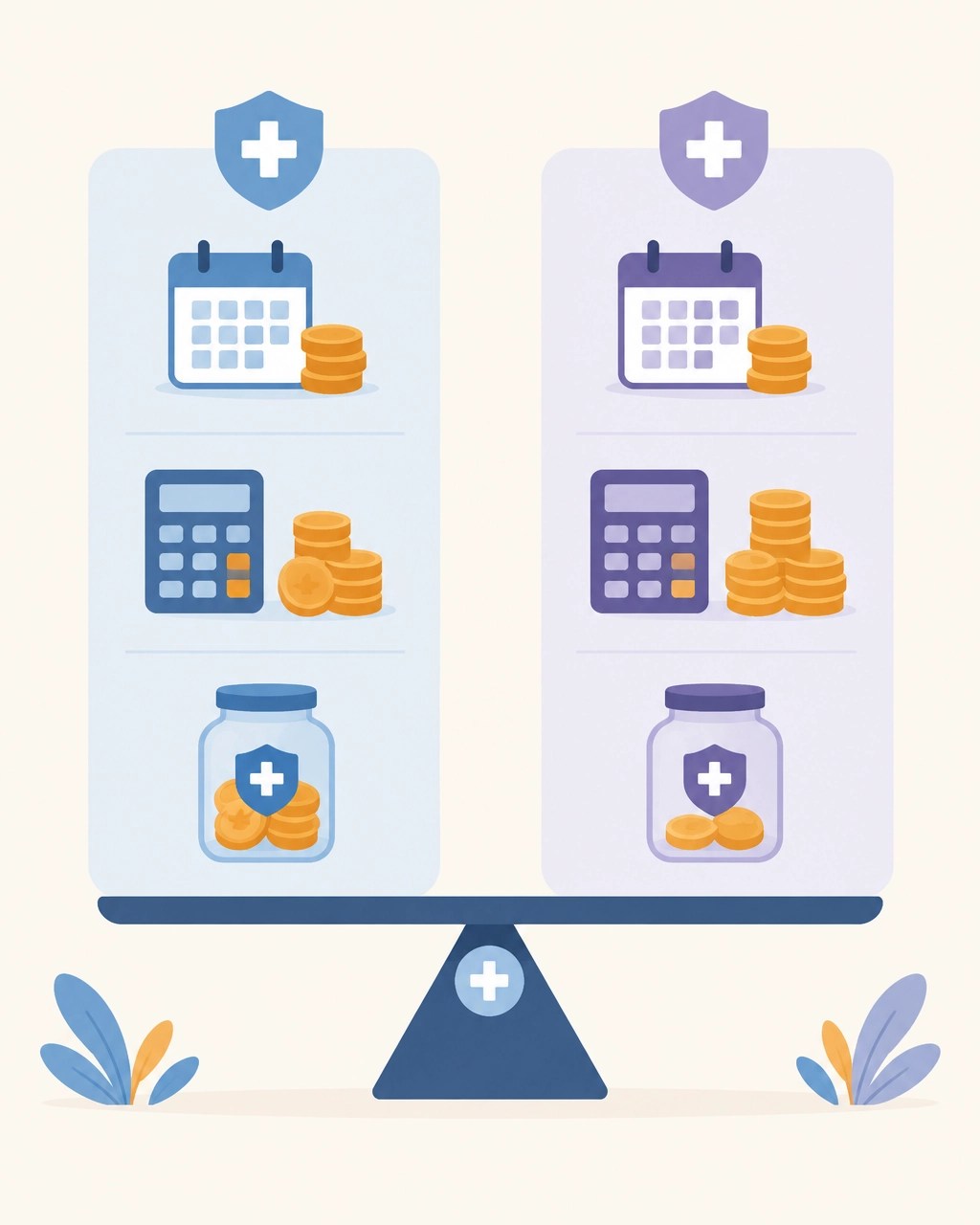
Illustrative single-person comparison
The figures below are hypothetical plan designs for illustration, not quotes. They assume annual allowed, covered in-network care of $500, $4,000, or $30,000. The example HDHP has a $5,000 deductible, 20% coinsurance after the deductible, and an $8,700 out-of-pocket maximum. The example Silver plan has a $1,500 deductible, selected service copays, 20% coinsurance after the deductible, and a $6,000 out-of-pocket maximum.
For illustration, the HDHP column assumes a $1,000 HSA contribution and a $200 tax benefit. That tax estimate assumes a hypothetical 20% tax benefit and will differ by person. The modeled cost totals are annual premiums plus estimated medical out-of-pocket costs, minus the assumed tax benefit; HSA contributions are not added again when they fund those medical expenses.
| Annual covered care used | HSA-qualified Bronze HDHP: estimated annual cost | Copay-style Silver: estimated annual cost |
|---|---|---|
| Low: $500 | $5,100 | $7,100 |
| Moderate: $4,000 | $8,600 | $8,600 |
| High: $30,000 | $13,300 | $12,600 |
The building blocks behind those totals: the HDHP has a $4,800 annual premium, medical out-of-pocket of $500, $4,000, and $8,700 at the three spending levels, a $1,000 HSA contribution, and a $200 assumed tax benefit. The Silver plan has a $6,600 annual premium and medical out-of-pocket of $500, $2,000, and $6,000.
In this illustration, the HDHP costs less in a low-use year, the plans are even at moderate use, and the Silver plan costs less in a high-use year. Actual results depend on the services used and the plan’s benefit rules. Real Fort Worth premiums vary by age, household size, tobacco use, and ZIP code, and the household’s eligible subsidy can change the comparison.
For 2027, the ACA maximum annual limit on in-network cost sharing for essential health benefits is $12,000 for self-only coverage and $24,000 for other-than-self-only coverage. That is the legal ceiling: a plan’s out-of-pocket maximum must be at or below it. Qualifying HDHPs have lower maximums of $8,700 and $17,400, respectively.
Who may benefit from an HDHP and HSA
An HDHP with an HSA may suit someone who expects low medical use, has limited prescription needs, and can set aside money to cover a higher deductible if care is needed. It may also appeal to self-employed people and those with 1099 income who want to make eligible HSA contributions.
The 2027 HSA contribution limits are $4,500 for self-only coverage and $9,000 for family coverage, plus a $1,000 catch-up contribution for eligible people age 55 and older. HSA contributions are not available to someone enrolled in Medicare, someone who can be claimed as another person’s tax dependent, or someone with other disqualifying coverage. Non-medical withdrawals before age 65 are taxed and may also incur a penalty.
A copay-style plan may be a better fit for someone with regular prescriptions, a planned procedure, a chronic condition requiring ongoing care, or a household that cannot comfortably pay a large deductible. More predictable copays can be useful, but the annual premium and the plan’s cost-sharing rules still need to be included in the estimate.
Fine print that changes the comparison
A copay may not count toward the deductible, even if it does count toward the out-of-pocket maximum. Check the plan documents to see how office visits and prescriptions are handled. Some prescriptions may be subject to the deductible, while others may have a copay before the deductible.
After the deductible, coinsurance can still leave the member responsible for part of the cost until the out-of-pocket maximum is reached. Out-of-network care may have separate deductibles, higher member costs, or limited coverage, so do not assume a PPO’s out-of-network terms make every provider affordable.
Network labels matter locally. A plan may be an HMO or EPO rather than a PPO, and network rules differ among plans. Before enrolling, confirm that the specific plan includes the Fort Worth doctors, hospitals, and pharmacies the household expects to use.

2027 enrollment checklist
- November 1, 2026–January 15, 2027: ACA Open Enrollment for 2027 coverage.
- December 15, 2026: Enroll by this date for coverage starting January 1, 2027.
- Before choosing: Compare premiums after any eligible subsidy, anticipated care costs, prescriptions, provider networks, and the out-of-pocket maximum.
- HSA contributions: Eligible contributions for the year can be made up to the tax filing deadline for that year.
The full enrollment dates and other plan-shopping steps are covered in DFW Health Coverage’s ACA Open Enrollment guide for DFW families. People between jobs who are also considering temporary coverage can review the separate guide to short-term health insurance in Texas; it is a different type of coverage from an ACA Marketplace plan.
Compare health insurance options in Fort Worth and DFW
The best choice depends on expected care, budget, tax eligibility, and the providers a household wants to keep. Comparing health insurance Fort Worth, TX options alongside wider health insurance DFW and health insurance Dallas Fort Worth choices helps households assess the trade-offs using their actual needs.
DFW Health Coverage works with all major carriers and offers free, no-obligation quotes to help people compare available plans. Request a quote with no obligation to buy, or call 682-551-1221.